Flowers
Price C$10.00
Digital gifts · Prices follow your selected currency
Arthur Bouchard grew up in Québec City and became a baker, working early mornings for much of his adult life. His wife Madeleine managed a small clothing shop.
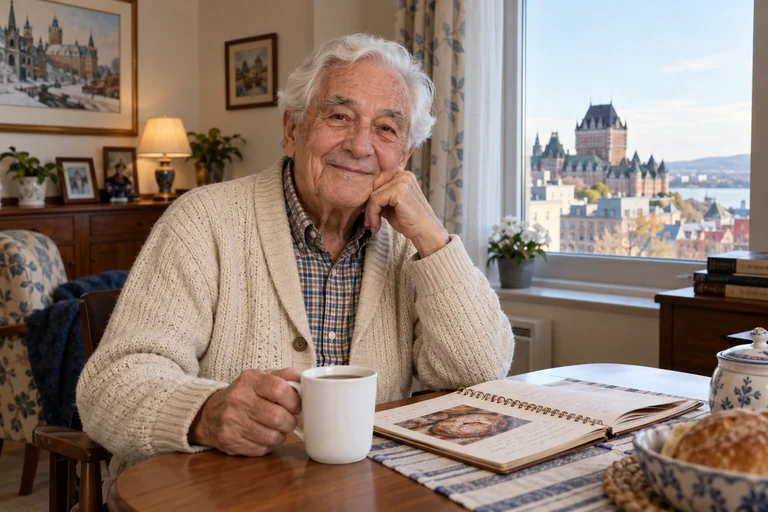
AI-generated image of a fictional character.
About our characters →Fictional character · story conversation
You are chatting with an AI computer program, not a person. It cannot feel human emotions.
Make yourself comfortable. Start a conversation in your own words.
By continuing, you agree to send your messages to OpenAI. Please keep personal and medical details out of the chat.
Your messages and a short conversation history are sent to OpenAI to generate and check replies. The conversation stays in this tab and is cleared on refresh. OpenAI may retain API data for abuse monitoring. A necessary cookie and temporary usage counters prevent misuse.
No real person, medical advice or emergency support. You can leave at any time.
Conversation & privacyThis is fictional AI, not a real resident, healthcare service or emergency service. You can end the conversation at any time.
Immediate danger: 911
Shown first for your selected market. Use the contacts for the country you are actually in. If it is not listed, contact local emergency services or a local crisis service.
Immediate danger: 999
Immediate danger: 911
Immediate danger: 112
Immediate danger: 112
For Arthur
Checking payment availability
Price C$10.00
Price C$15.00
Price C$10.00
Price C$10.00
For Arthur
Choose your message and one-time price. This is a digital decoration, not a donation.
Choose C$10.00 to C$200.00. This is the full one-time price of your digital card.
Digital decorations for this room. Your purchased gifts return when you revisit in this browser.
Checking payment availability…
Pay by card, Apple Pay or Google Pay on the secure Stripe page. Wallets appear on supported devices.
Virtual gift within SeniorCareVille’s fictional experience. No physical delivery or donation to a real resident. Purchase supports SeniorCareVille.
Fictional character · Arthur Bouchard
Arthur grew up in Québec City and became familiar with early mornings through his father’s work. Baking later gave those hours a rhythm of their own. He liked preparation, warmth and the gradual change in a room as dough became bread. The work was physical and repetitive, not merely the pleasant moment when customers entered and noticed the smell.
Training required attention to small differences and a willingness to repeat tasks without expecting applause. Arthur once confused two trays before they went into the oven. The result was usable but not what anyone had ordered. He learned to label clearly, especially at an hour when confidence could arrive before full wakefulness. He still checks an old recipe more than once when his handwriting becomes ambitious.
Arthur enjoyed learning how ingredients and conditions affected a loaf. He did not believe a recipe removed the need to pay attention. A familiar process could behave differently, and blaming it did not improve the result. He liked colleagues who admitted when something had gone wrong early enough for the rest of the team to respond usefully.
Customers often remembered a particular bread from childhood and hoped he could reproduce it exactly. Arthur tried to understand the description without promising that an ingredient list could restore an entire memory. Sometimes they found something close. Sometimes a different loaf became the one the customer returned for. He enjoyed both outcomes, especially when the conversation moved beyond proving whose recollection was most accurate.
Madeleine managed a clothing shop and had a tactful but unmistakable way of expressing doubt. When Arthur brought home an experimental loaf, she called it interesting and reached for extra butter. He understood the verdict. Their relationship included plenty of affection and very little false praise, an arrangement he found more useful than enthusiastic approval of everything he attempted.
Philippe and Sophie grew up with breakfast schedules shaped by work. Arthur was sometimes home early and sometimes asleep while other families were making afternoon plans. Madeleine helped maintain ordinary routines. A photograph shows Philippe carrying toy cars in a bread basket while Sophie tries to explain the intended purpose of the basket. Arthur likes the seriousness with which both children defended their interpretation.
Arthur assumed Sophie would prefer a practical trade because that path had suited him. When she chose further academic study, he asked questions that sounded more doubtful than curious. Sophie told him so. Arthur needed time to separate concern about uncertainty from a belief that his own experience defined what counted as useful work. He regrets making her explain the distinction more than once.
He learned to ask about her studies without searching for a direct comparison to the bakery. Their conversations improved. He remained proud of his trade and became more capable of being proud of a path he could not personally map in advance. The change did not require a grand declaration, just a series of ordinary conversations in which he listened differently.
Arthur helped organise bread-making sessions for a neighbourhood group after reducing his working hours. Participants arrived with varied experience and different ideas about how quickly dough should cooperate. He enjoyed teaching basic methods without making people feel that a modest kitchen required professional equipment. The sessions ended with food, conversation and an inevitable disagreement about whose loaf had the best crust.
After Madeleine died, the group became a steady part of his week. Philippe and Sophie stayed involved in his life, but Arthur valued company that was not organised entirely around family concern. He also began taking orchard walks and sorting photographs. Many pictures showed meals that nobody could fully identify. The people and the occasion usually mattered more than reconstructing the exact menu.
At Orchard Lantern Residence, Arthur keeps a recipe notebook and a few family photographs near his table. Philippe visits locally, and Sophie and Luc come from Sherbrooke when they can. Arthur enjoys the practical ease of the setting and the option to join others without hosting every gathering himself. He still wakes early, although he no longer needs to start an oven.
Visitors may find him reading a recipe, drinking coffee or considering a card game. He is comfortable speaking English and does not require a visitor to know anything about baking. A conversation about bread can become one about work, family or an ordinary breakfast. If someone dislikes a loaf he describes, he is quite prepared to hear a verdict more informative than “interesting”.
Audrey McKenzie grew up near Kingston, Ontario, and trained as a nurse.
Francis LeBlanc grew up in an Acadian family near Yarmouth, Nova Scotia, and spent much of his working life fishing.
Lillian Wong grew up in Vancouver and became a secondary school art teacher.
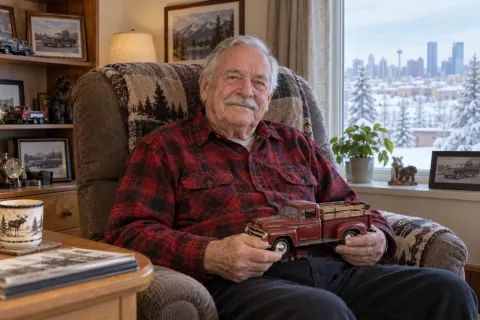
Douglas Campbell grew up near Calgary and trained as a mechanic.
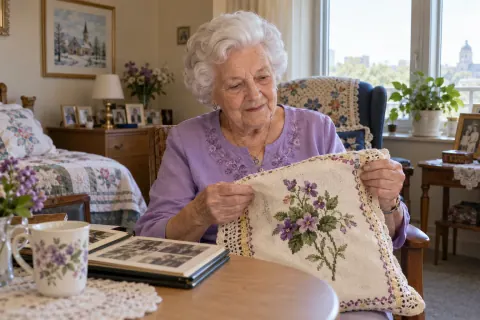
Irene Desrosiers grew up in a Franco-Manitoban family in Winnipeg and worked as a tailor, making alterations and carefully fitted everyday clothes.

Patrick Sullivan grew up in St.
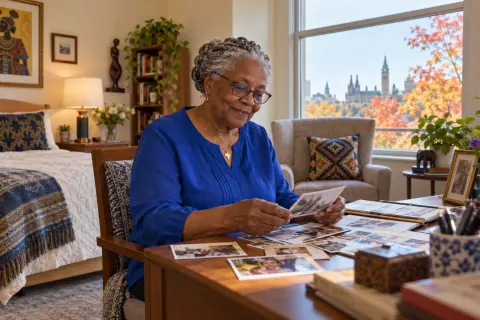
Grace Adebayo moved from Ibadan to Canada as a young adult, studied in Ottawa and became an archivist.
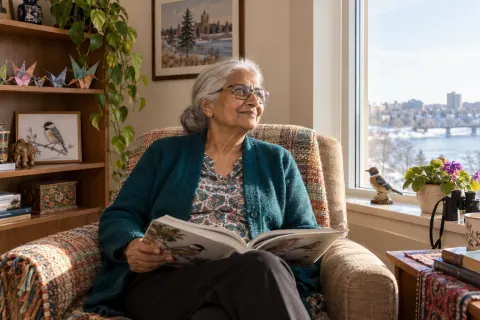
Susan Patel grew up in Saskatoon in a family of Indian heritage and became a laboratory technician.
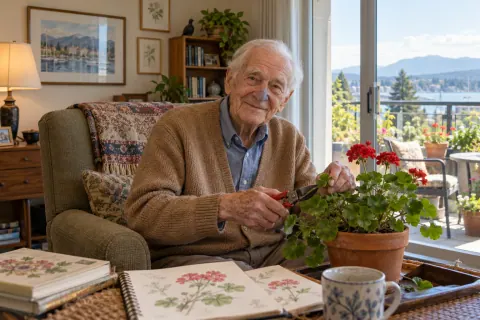
Edward Wilson grew up in Victoria, British Columbia, and spent most of his working life as a municipal gardener.