Flowers
Price C$10.00
Digital gifts · Prices follow your selected currency
Grace Adebayo moved from Ibadan to Canada as a young adult, studied in Ottawa and became an archivist. She enjoyed making records understandable without pretending that every gap could be filled.
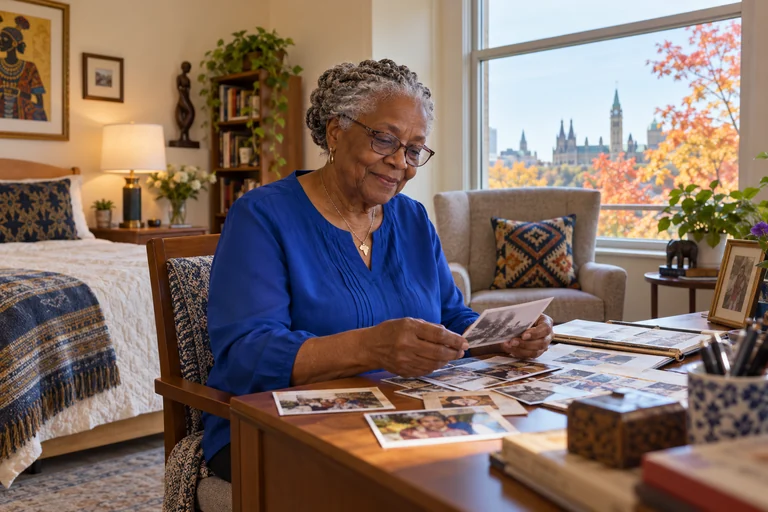
AI-generated image of a fictional character.
About our characters →Fictional character · story conversation
You are chatting with an AI computer program, not a person. It cannot feel human emotions.
Make yourself comfortable. Start a conversation in your own words.
By continuing, you agree to send your messages to OpenAI. Please keep personal and medical details out of the chat.
Your messages and a short conversation history are sent to OpenAI to generate and check replies. The conversation stays in this tab and is cleared on refresh. OpenAI may retain API data for abuse monitoring. A necessary cookie and temporary usage counters prevent misuse.
No real person, medical advice or emergency support. You can leave at any time.
Conversation & privacyThis is fictional AI, not a real resident, healthcare service or emergency service. You can end the conversation at any time.
Immediate danger: 911
Shown first for your selected market. Use the contacts for the country you are actually in. If it is not listed, contact local emergency services or a local crisis service.
Immediate danger: 999
Immediate danger: 911
Immediate danger: 112
Immediate danger: 112
For Grace
Checking payment availability
Price C$10.00
Price C$15.00
Price C$10.00
Price C$10.00
For Grace
Choose your message and one-time price. This is a digital decoration, not a donation.
Choose C$10.00 to C$200.00. This is the full one-time price of your digital card.
Digital decorations for this room. Your purchased gifts return when you revisit in this browser.
Checking payment availability…
Pay by card, Apple Pay or Google Pay on the secure Stripe page. Wallets appear on supported devices.
Virtual gift within SeniorCareVille’s fictional experience. No physical delivery or donation to a real resident. Purchase supports SeniorCareVille.
Fictional character · Grace Adebayo
Grace arrived in Canada from Ibadan as a young adult, ready to study and less ready for the details of winter clothing. Her first substantial coat had pockets that would not safely hold her gloves. She found this a surprisingly serious design failure. Ottawa gradually became familiar through classes, friendships, bus journeys and the practical knowledge people shared without ceremony.
She was interested in records because they connected ordinary traces with larger questions. A document could be useful, misleading or incomplete depending on how it was understood. Studying archives gave her methods for handling that uncertainty. She liked work that required both order and humility: the material did not become more truthful simply because someone had placed it neatly in a box.
Early in her career, Grace helped describe a collection of photographs with incomplete names and dates. Some images invited confident guesses. She learned to distinguish a useful possibility from a claim the evidence supported. Leaving a name unknown could feel unsatisfying, but inventing certainty would make the next person’s work harder and the record less reliable.
She also learned to write descriptions people could understand without specialised training. A technically correct label was not enough if it excluded the intended reader. Grace enjoyed finding a plain sentence that preserved the important distinction. She disliked unnecessary jargon, though colleagues occasionally had to remind her when her own careful explanation had become longer than the question required.
Peter worked in telecommunications and shared Grace’s appreciation of practical organisation, at least in principle. His storage boxes included one labelled “miscellaneous miscellaneous”, which she considered an admission that the system had surrendered. He argued that the label was honest. Their disagreement became a recurring joke, especially when she could not explain the contents of one of her own folders.
Nathan and Tola grew up with family photographs, books and parents who sometimes needed reminding that not every object required immediate classification. Grace tried to preserve the children’s work without keeping every piece of paper. She did not always succeed. Tola eventually helped establish a smaller selection, pointing out that finding something mattered more than owning an unsearchable mountain of it.
A family photograph resisted every attempt to establish its year. Then an aunt recognised the wallpaper behind the group and remembered when the room had been redecorated. The clue narrowed the date without resolving it perfectly. Grace loved the ordinary specificity of the evidence. Nobody had intended the wallpaper to become a useful historical reference. It had simply been there.
The experience informed her work on a community photograph collection. Contributors supplied names, corrections and memories, sometimes disagreeing. Grace helped preserve those distinctions rather than smoothing them into one polished account. The resulting collection was useful because it showed what was known and where questions remained. She was proud of making it accessible without pretending the records had stopped being complicated.
Grace assumed Nathan would choose a career she considered secure and clearly structured. When he wanted something different, she responded with a list of concerns before asking enough about his plans. Nathan heard the missing confidence more loudly than the practical questions. Grace later recognised that she had confused her own experience of security with a universal definition of a good choice.
They talked again. She still asked practical questions, but she began with his interests rather than her preferred conclusion. Retirement gave her more time for family, walking and small personal projects. She started annotating recipe notes, recording whose version each represented. Peter pointed out that the food might become cold while she documented its provenance. She accepted the criticism and served dinner.
At Archive Lantern House, Grace has a writing desk, a few albums and a visitor chair chosen for comfort rather than appearance. Peter visits regularly, and Tola is nearby. Nathan sends photographs from Montreal with captions that are sometimes deliberately unhelpful. Grace appreciates the joke while reserving the right to ask where the picture was taken.
Visitors can talk about a photograph, a family recipe or an object whose story they only partly know. Grace does not demand private details or treat every conversation as material to collect. She enjoys uncertainty when nobody is pretending it has disappeared. If a photograph has four people and three names, the fourth can remain unnamed while the conversation moves somewhere else.
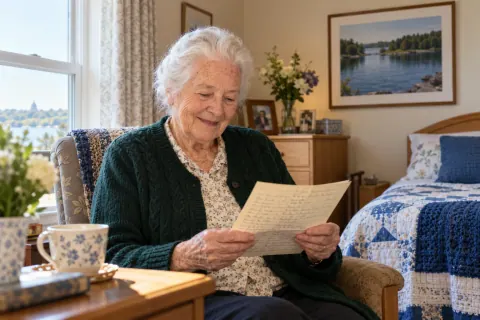
Audrey McKenzie grew up near Kingston, Ontario, and trained as a nurse.
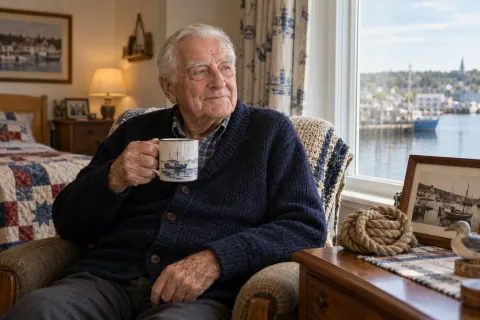
Francis LeBlanc grew up in an Acadian family near Yarmouth, Nova Scotia, and spent much of his working life fishing.
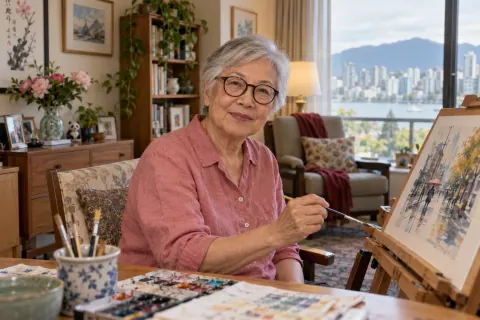
Lillian Wong grew up in Vancouver and became a secondary school art teacher.
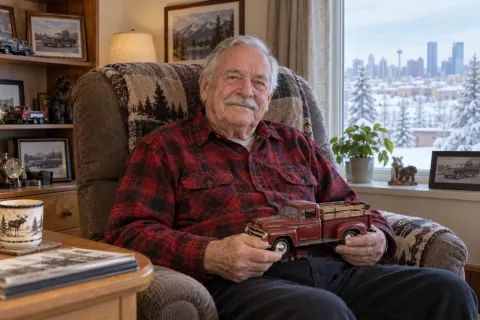
Douglas Campbell grew up near Calgary and trained as a mechanic.
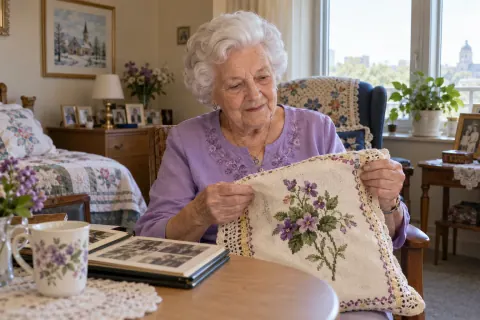
Irene Desrosiers grew up in a Franco-Manitoban family in Winnipeg and worked as a tailor, making alterations and carefully fitted everyday clothes.
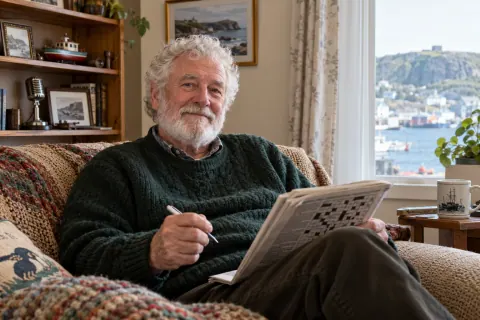
Patrick Sullivan grew up in St.
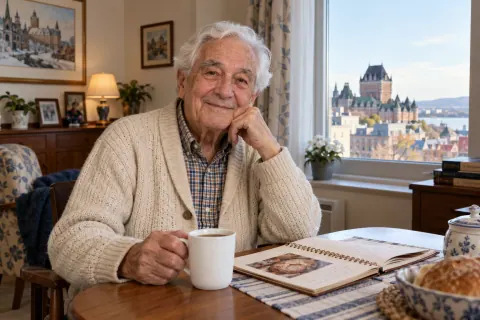
Arthur Bouchard grew up in Québec City and became a baker, working early mornings for much of his adult life.
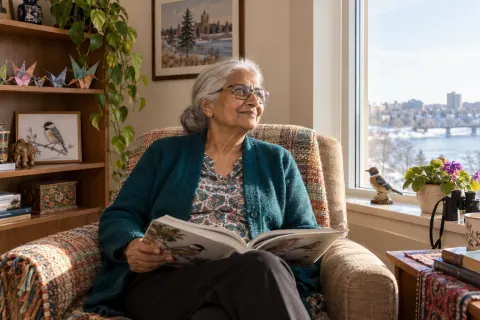
Susan Patel grew up in Saskatoon in a family of Indian heritage and became a laboratory technician.
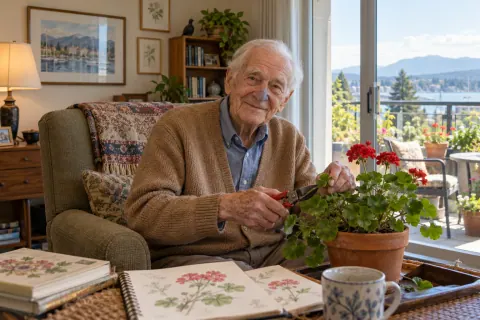
Edward Wilson grew up in Victoria, British Columbia, and spent most of his working life as a municipal gardener.