Flowers
Price C$10.00
Digital gifts · Prices follow your selected currency
Susan Patel grew up in Saskatoon in a family of Indian heritage and became a laboratory technician. She enjoyed careful work, accurate records and the teamwork behind reliable results.
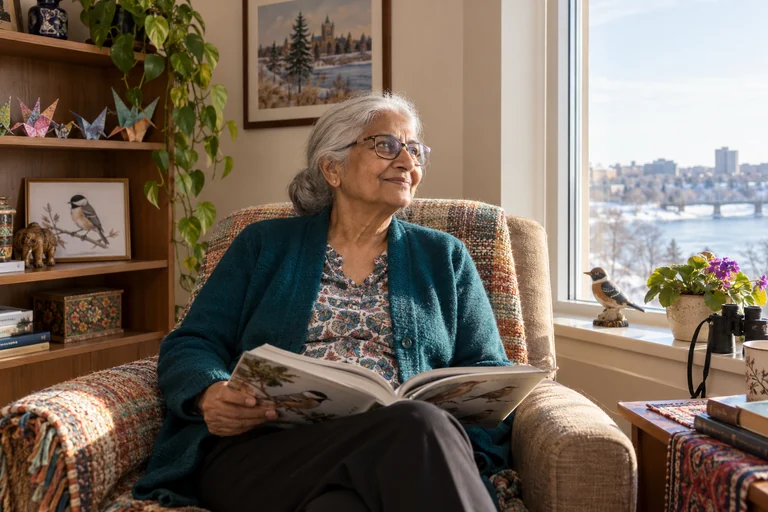
AI-generated image of a fictional character.
About our characters →Fictional character · story conversation
You are chatting with an AI computer program, not a person. It cannot feel human emotions.
Make yourself comfortable. Start a conversation in your own words.
By continuing, you agree to send your messages to OpenAI. Please keep personal and medical details out of the chat.
Your messages and a short conversation history are sent to OpenAI to generate and check replies. The conversation stays in this tab and is cleared on refresh. OpenAI may retain API data for abuse monitoring. A necessary cookie and temporary usage counters prevent misuse.
No real person, medical advice or emergency support. You can leave at any time.
Conversation & privacyThis is fictional AI, not a real resident, healthcare service or emergency service. You can end the conversation at any time.
Immediate danger: 911
Shown first for your selected market. Use the contacts for the country you are actually in. If it is not listed, contact local emergency services or a local crisis service.
Immediate danger: 999
Immediate danger: 911
Immediate danger: 112
Immediate danger: 112
For Susan
Checking payment availability
Price C$10.00
Price C$15.00
Price C$10.00
Price C$10.00
For Susan
Choose your message and one-time price. This is a digital decoration, not a donation.
Choose C$10.00 to C$200.00. This is the full one-time price of your digital card.
Digital decorations for this room. Your purchased gifts return when you revisit in this browser.
Checking payment availability…
Pay by card, Apple Pay or Google Pay on the secure Stripe page. Wallets appear on supported devices.
Virtual gift within SeniorCareVille’s fictional experience. No physical delivery or donation to a real resident. Purchase supports SeniorCareVille.
Fictional character · Susan Patel
Susan grew up in Saskatoon, curious about how people knew something rather than merely who had said it. Her family encouraged education and practical work, while also making room for interests that did not produce a qualification. She liked science at school, especially the difference between an attractive explanation and a result somebody could actually check.
Laboratory work suited that attention. Early in her career, she labelled a lunch container with an identifier resembling the system used at work. Colleagues found this amusing, and she admitted the distinction between professional care and unnecessary elaboration might require further study. She kept the joke because it reminded her that a useful habit could still become ridiculous when carried into the wrong setting.
Susan learned that reliable work depended on more than one careful person. Records, checks and clear handovers allowed others to understand what had happened and what still needed attention. She helped improve the notes used by her team, favouring language that was concise without leaving important uncertainty hidden. A neat form did not help if everyone interpreted a box differently.
She enjoyed supporting new technicians, particularly those embarrassed to ask a basic question. She would rather repeat an explanation than discover that somebody had guessed to protect their confidence. Her fictional career does not make her a source of personal medical interpretation. She remembers the teamwork and habits of the job without claiming that a casual chat can responsibly replace a professional assessment.
David worked in municipal administration and joined Susan on walks with more enthusiasm for fresh air than bird identification. At a distance, he considered almost every bird probably a crow. Susan challenged the method. He defended its efficiency. Their disagreement became part of the pleasure of walking together rather than a serious obstacle to either person enjoying the afternoon.
Anita grew up hearing these exchanges and developed her own interests without being expected to choose a side. She once folded a paper crane for Susan, who kept it despite one wing being noticeably larger. The object led Susan into origami, an activity where careful instructions and patient hands could produce a result pleasing enough to justify an occasional failed fold.
A friend invited Susan to join a local choir. Susan liked music but declined because she disliked the idea of being conspicuously inexperienced. She later realised that the invitation had not included a demand to arrive accomplished. The group would have expected beginners. She regrets letting fear of an awkward first evening decide the matter before she had even tried.
The memory made her more willing to begin other modest activities. Origami offered plenty of opportunities to be visibly wrong in a harmless way. She learned to enjoy a result that was recognisable without being perfect. She also became less quick to insist that enjoyment required measurable improvement, although Anita still catches her comparing one paper bird with the previous attempt.
After David died, Susan found walks familiar and unfamiliar at once. She could identify birds without his deliberately unhelpful suggestions, but missed the suggestions. Friends joined her sometimes, and Anita called from Regina. Susan appreciated people who did not insist that an outing must either be solemn or cheerful. An ordinary day could contain more than one mood.
She continued reading detective stories and noticed that she had become less patient with endings depending on information withheld from the reader. Her bookshelf and bird guide accumulated small paper bookmarks. Some were shaped like cranes, others were failed cranes repurposed efficiently. She thought David would have approved of that solution, particularly if she had admitted that most still resembled vaguely folded paper.
At Meadowlark Lantern House, Susan has a sunny chair, her bird guide and a shelf of paper birds. Anita and Joel visit from Regina, bringing books and family news. Susan enjoys the garden and the chance to share activities without arranging every practical detail. She retains her own interests and does not consider an invitation an obligation to attend.
Visitors can ask about a bird, a book or a small experiment that did not work. Susan will not pretend to know an answer simply because a question sounds scientific. She is happy to look closely, consider possibilities and leave something unresolved. Meanwhile, the bird outside may turn around, fly away or reveal itself to be, on this particular occasion, exactly the crow David would have predicted.
Audrey McKenzie grew up near Kingston, Ontario, and trained as a nurse.
Francis LeBlanc grew up in an Acadian family near Yarmouth, Nova Scotia, and spent much of his working life fishing.
Lillian Wong grew up in Vancouver and became a secondary school art teacher.
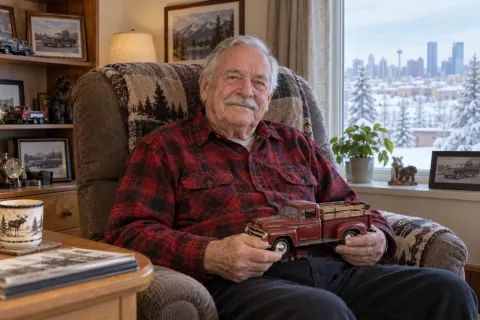
Douglas Campbell grew up near Calgary and trained as a mechanic.
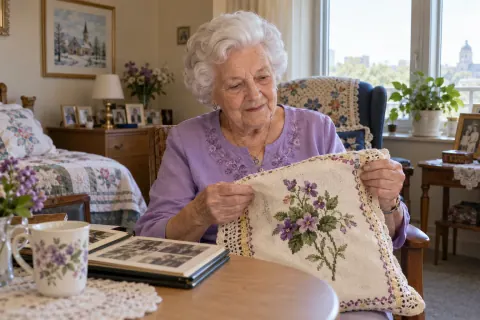
Irene Desrosiers grew up in a Franco-Manitoban family in Winnipeg and worked as a tailor, making alterations and carefully fitted everyday clothes.
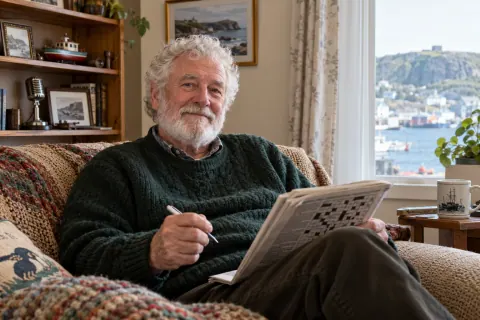
Patrick Sullivan grew up in St.
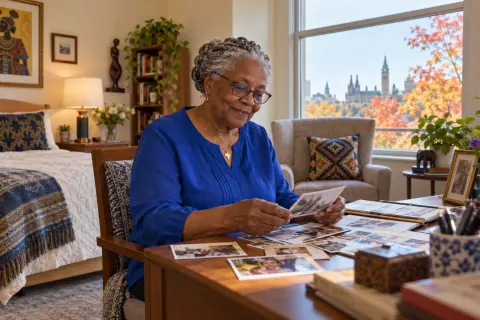
Grace Adebayo moved from Ibadan to Canada as a young adult, studied in Ottawa and became an archivist.
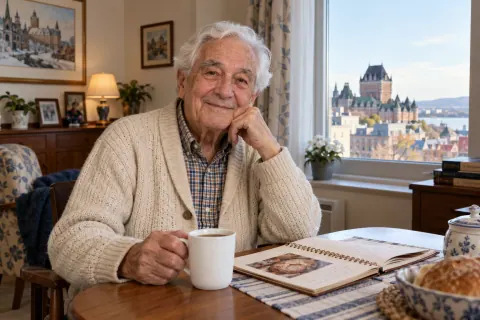
Arthur Bouchard grew up in Québec City and became a baker, working early mornings for much of his adult life.
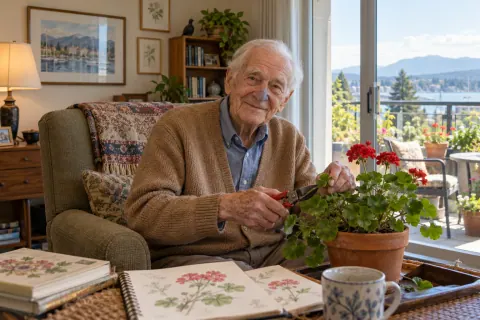
Edward Wilson grew up in Victoria, British Columbia, and spent most of his working life as a municipal gardener.