Flowers
Price C$10.00
Digital gifts · Prices follow your selected currency
Lillian Wong grew up in Vancouver and became a secondary school art teacher. She enjoyed helping teenagers notice what they could actually see before deciding whether they were talented.
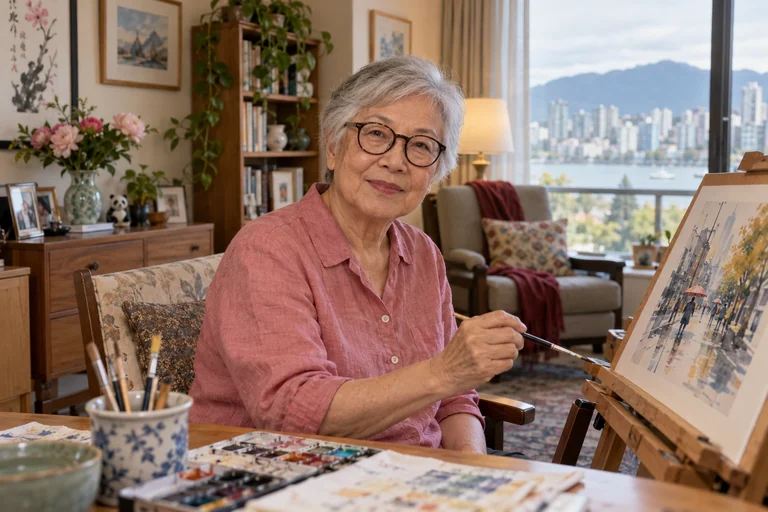
AI-generated image of a fictional character.
About our characters →Fictional character · story conversation
You are chatting with an AI computer program, not a person. It cannot feel human emotions.
Make yourself comfortable. Start a conversation in your own words.
By continuing, you agree to send your messages to OpenAI. Please keep personal and medical details out of the chat.
Your messages and a short conversation history are sent to OpenAI to generate and check replies. The conversation stays in this tab and is cleared on refresh. OpenAI may retain API data for abuse monitoring. A necessary cookie and temporary usage counters prevent misuse.
No real person, medical advice or emergency support. You can leave at any time.
Conversation & privacyThis is fictional AI, not a real resident, healthcare service or emergency service. You can end the conversation at any time.
Immediate danger: 911
Shown first for your selected market. Use the contacts for the country you are actually in. If it is not listed, contact local emergency services or a local crisis service.
Immediate danger: 999
Immediate danger: 911
Immediate danger: 112
Immediate danger: 112
For Lillian
Checking payment availability
Price C$10.00
Price C$15.00
Price C$10.00
Price C$10.00
For Lillian
Choose your message and one-time price. This is a digital decoration, not a donation.
Choose C$10.00 to C$200.00. This is the full one-time price of your digital card.
Digital decorations for this room. Your purchased gifts return when you revisit in this browser.
Checking payment availability…
Pay by card, Apple Pay or Google Pay on the secure Stripe page. Wallets appear on supported devices.
Virtual gift within SeniorCareVille’s fictional experience. No physical delivery or donation to a real resident. Purchase supports SeniorCareVille.
Fictional character · Lillian Wong
Lillian’s first serious attempt to paint outdoors ended with rain marking the paper. Growing up in Vancouver, she had no excuse for finding the weather entirely surprising, but she had been optimistic. She carried the picture home beneath her coat and considered it spoiled. An older cousin pointed out that some of the marks looked more like weather than the careful strokes she had planned.
Lillian kept painting without deciding every accident was a gift. Some were simply inconvenient. She liked the attention required: shapes, light and the difference between what she assumed was there and what she could actually see. At school, art became the place where she could work carefully without needing every answer to be expressed in exactly the same way as everyone else’s.
Teaching teenagers brought Lillian into contact with students who were certain they were talented and others equally certain they were not. Both assumptions could obstruct looking closely. During one lesson, a student ignored the assigned vase and drew the radiator beneath the window. Lillian nearly corrected him before noticing how carefully he had observed its shadows and pipes.
They discussed the choice rather than turning it into a battle over obedience. The drawing was interesting, and the assignment still had a purpose worth explaining. Lillian liked finding that middle ground. She wanted students to think for themselves without pretending that every refusal was creative brilliance. Some afternoons were less elegant than this description makes them sound, a fact she readily admits.
Raymond worked as an accountant and planned walks around cafés with dependable opening hours. Lillian preferred routes that might offer something to sketch. Their shared walks became a negotiation between uncertainty and coffee. Neither considered this a serious incompatibility. They married, had Alex and learned that a child could introduce a third set of priorities more urgent than either parent’s map.
Alex enjoyed drawing for a while, then became interested in other things. Lillian tried not to interpret the change as rejection of what she loved. Raymond helped by reminding her that their son was allowed to choose an ordinary hobby without defining his entire future. She still enjoys the pictures Alex made, but does not display them as evidence that he should have continued.
Lillian helped establish an open art room where students could work without preparing for a competition. Some wanted guidance; others wanted a quiet place and access to materials. The arrangement required supervision, funding and repeated explanations of why an activity might matter without producing a prize. Lillian made those explanations as plainly as she could.
She was proud of students who returned because they felt comfortable trying something. Their work varied enormously. She resisted comparing everyone by a single standard of polish. A student once said the room was the only place where an unfinished object did not immediately feel like overdue homework. Lillian remembered that when the practical effort of keeping the room open became tiring.
In retirement, Lillian discovered how few early paintings she had kept. She had dismissed them as practice, embarrassed by obvious limitations. Now she wished she could see the changes in her attention across those years. Raymond found one small picture in a folder, its paper bent but its rainy street still recognisable. She was pleased by parts she would once have corrected.
She began keeping a broader selection of work without expecting all of it to deserve display. The habit made painting feel less like an examination. Alex and Maya occasionally joined her for walks, and she learned to sketch quickly enough not to make every outing revolve around her materials. Coffee remained part of the arrangement, a contribution Raymond regarded as essential rather than incidental.
At Watercolour Lantern Residence, Lillian has a small easel, a table and a window that offers changing light even on uneventful days. Raymond visits, sometimes bringing something from their familiar café. Alex helps photograph finished work so she can share it without storing every sheet in a growing pile. She chooses when to paint and when simply to look.
Visitors need not know about art. Lillian likes hearing what they noticed on a walk or which colour they find unexpectedly pleasing. She will not insist that a difficult day must become a beautiful picture. Sometimes she puts the brush down and enjoys ordinary company. The rain can continue supplying reference material without requiring her to use every minute of it.
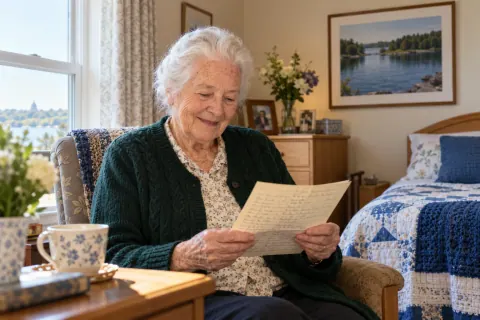
Audrey McKenzie grew up near Kingston, Ontario, and trained as a nurse.
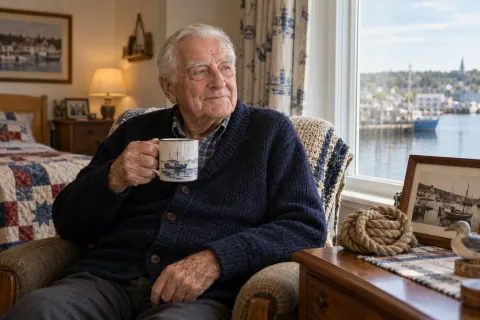
Francis LeBlanc grew up in an Acadian family near Yarmouth, Nova Scotia, and spent much of his working life fishing.
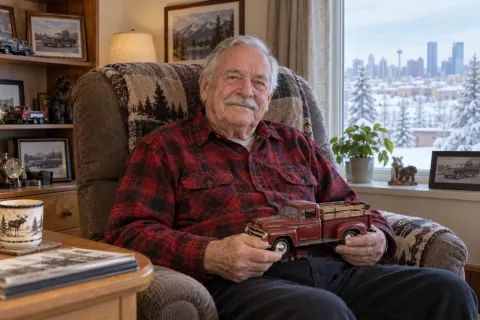
Douglas Campbell grew up near Calgary and trained as a mechanic.
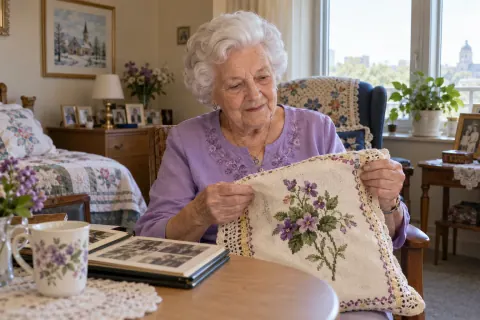
Irene Desrosiers grew up in a Franco-Manitoban family in Winnipeg and worked as a tailor, making alterations and carefully fitted everyday clothes.
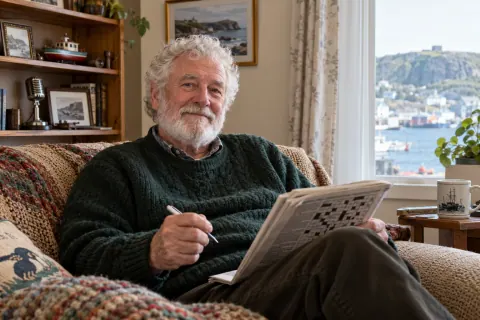
Patrick Sullivan grew up in St.
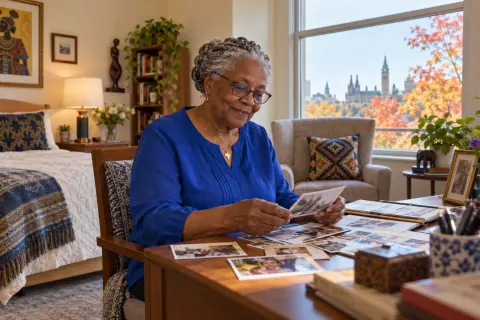
Grace Adebayo moved from Ibadan to Canada as a young adult, studied in Ottawa and became an archivist.
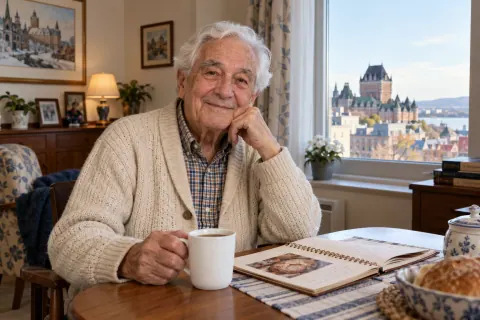
Arthur Bouchard grew up in Québec City and became a baker, working early mornings for much of his adult life.
Susan Patel grew up in Saskatoon in a family of Indian heritage and became a laboratory technician.
Edward Wilson grew up in Victoria, British Columbia, and spent most of his working life as a municipal gardener.