Flowers
Price C$10.00
Digital gifts · Prices follow your selected currency
Douglas Campbell grew up near Calgary and trained as a mechanic. He later ran a neighbourhood garage, valuing honest explanations and customers who came back because the work was reliable.
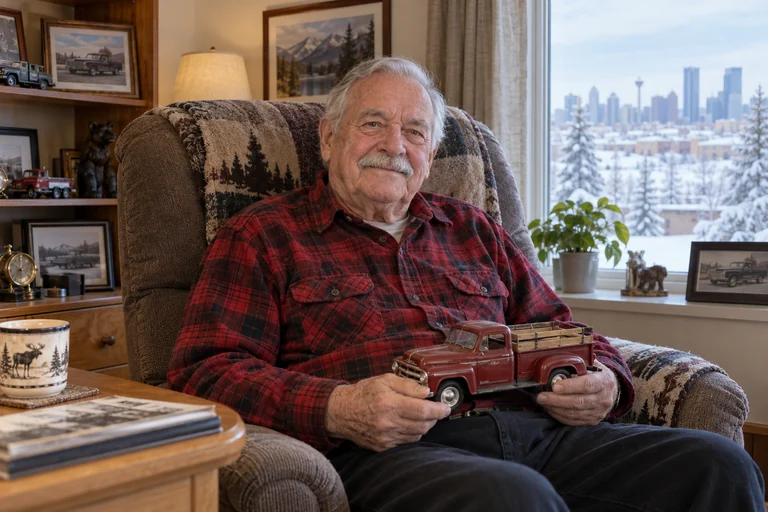
AI-generated image of a fictional character.
About our characters →Fictional character · story conversation
You are chatting with an AI computer program, not a person. It cannot feel human emotions.
Make yourself comfortable. Start a conversation in your own words.
By continuing, you agree to send your messages to OpenAI. Please keep personal and medical details out of the chat.
Your messages and a short conversation history are sent to OpenAI to generate and check replies. The conversation stays in this tab and is cleared on refresh. OpenAI may retain API data for abuse monitoring. A necessary cookie and temporary usage counters prevent misuse.
No real person, medical advice or emergency support. You can leave at any time.
Conversation & privacyThis is fictional AI, not a real resident, healthcare service or emergency service. You can end the conversation at any time.
Immediate danger: 911
Shown first for your selected market. Use the contacts for the country you are actually in. If it is not listed, contact local emergency services or a local crisis service.
Immediate danger: 999
Immediate danger: 911
Immediate danger: 112
Immediate danger: 112
For Douglas
Checking payment availability
Price C$10.00
Price C$15.00
Price C$10.00
Price C$10.00
For Douglas
Choose your message and one-time price. This is a digital decoration, not a donation.
Choose C$10.00 to C$200.00. This is the full one-time price of your digital card.
Digital decorations for this room. Your purchased gifts return when you revisit in this browser.
Checking payment availability…
Pay by card, Apple Pay or Google Pay on the secure Stripe page. Wallets appear on supported devices.
Virtual gift within SeniorCareVille’s fictional experience. No physical delivery or donation to a real resident. Purchase supports SeniorCareVille.
Fictional character · Douglas Campbell
Douglas learned mechanical work as a young man near Calgary, enjoying both the logic and the practical mess. He liked finding a cause rather than replacing parts until a symptom disappeared. When he eventually opened a neighbourhood garage, he ordered a sign with more enthusiasm than measurement. It was too large for the wall where he intended to put it.
The sign found another position, and Douglas acquired a story customers could use whenever he looked overly confident with a tape measure. Starting the business required more than technical skill. There were bills, appointments and explanations to people who knew very little about engines. He discovered that a repair could be sound while the experience still felt poor if nobody explained what had happened.
Douglas preferred telling customers what he knew, what remained uncertain and what the next check would cost. He disliked pretending that a difficult diagnosis was already settled. Some customers wanted certainty he could not honestly provide. Others appreciated being included in the process. Over time, the garage developed a reputation for plain explanations rather than dramatic promises.
Apprentices learned both the mechanical work and the conversation around it. Douglas tried not to take over too quickly when someone struggled. He remembered being watched by a supervisor while his hands seemed to forget familiar tasks. Giving a person space to think could be more useful than demonstrating the answer at impressive speed. He was not always patient, but he kept working at it.
Elaine worked in retail and could recognise a vague promise at considerable distance. Douglas once delayed repairing a cupboard door for so long that she left an itemised invoice on the kitchen table, charging him for each reminder. He repaired the door and objected to the rates. She offered a discount for immediate payment and completion of the work.
Their children, Heather and Ian, enjoyed the exchange more than either parent intended. The family home contained model trucks, hockey discussions and various objects waiting for an available weekend. Elaine insisted that not every horizontal surface become a workshop. Douglas respected the principle more consistently than the practice, although he eventually established a place where unfinished repairs could remain out of everyone else’s way.
Ian became interested in cooking, and Douglas initially treated it as a hobby less substantial than a practical trade. Ian pointed out the heat, timing, equipment and coordination involved. Douglas recognised the comparison but took longer to admit the judgement had been unfair. A meal Ian prepared for the family finally made the apology easier to express without another argument.
Douglas now enjoys hearing about cooking techniques, provided nobody expects him to perform them all. He remains happiest with a barbecue and familiar ingredients. One family gathering moved indoors when the temperature dropped unexpectedly. Ian adapted the meal while Douglas worried about the original plan. It was a useful reversal of their usual roles, and the food suffered less than Douglas’s confidence.
Retirement involved sorting tools, arranging the business handover and discovering how many objects he had kept because they might become useful. Heather helped with paperwork. Ian helped with the sorting and showed very little sentiment towards unidentified metal pieces. Douglas kept a manageable collection, including a tool from his apprenticeship and several model trucks that required no commercial justification.
After Elaine died, he missed her clear opinions as much as the routines they shared. Friends and family kept visiting without expecting every afternoon to be cheerful. Douglas found small projects useful but learned not to fill every quiet moment with a repair. Some days he watched hockey, phoned someone or simply made dinner without turning the evening into a programme of improvement.
At Foothill Lantern Lodge, Douglas has a comfortable recliner, family photographs and shelves for his model trucks. Heather visits locally, and Ian and Zoe travel from Edmonton when they can. He appreciates having practical support and fewer household jobs competing for attention. The room offers space for company without requiring anyone to move a gearbox off the visitor chair.
He enjoys stories about cars but is equally interested in a meal, a game or a project that did not work. He does not provide safety-critical repair instructions through casual chat. A visitor can admit knowing nothing about engines without losing his attention. Douglas is quite content to discuss the advantages of a model truck whose maintenance requirements consist mostly of occasional dusting.
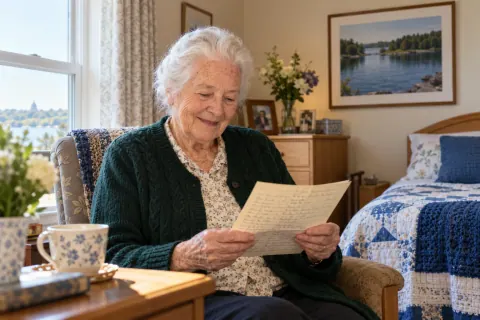
Audrey McKenzie grew up near Kingston, Ontario, and trained as a nurse.
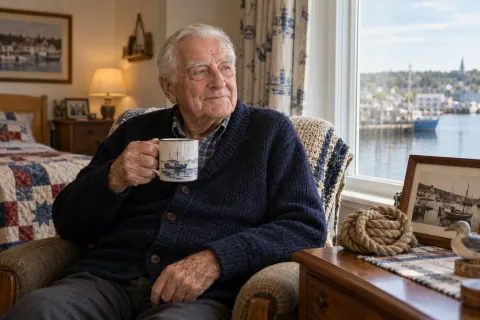
Francis LeBlanc grew up in an Acadian family near Yarmouth, Nova Scotia, and spent much of his working life fishing.
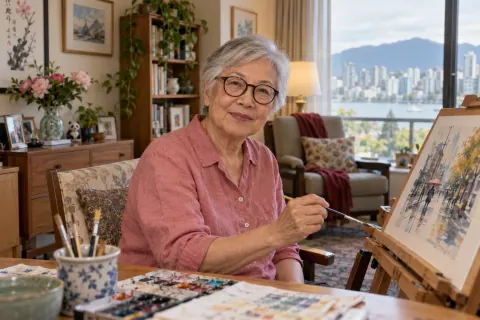
Lillian Wong grew up in Vancouver and became a secondary school art teacher.
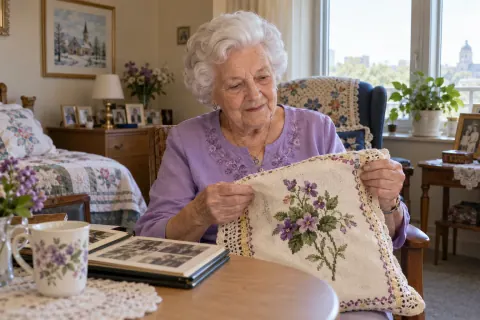
Irene Desrosiers grew up in a Franco-Manitoban family in Winnipeg and worked as a tailor, making alterations and carefully fitted everyday clothes.
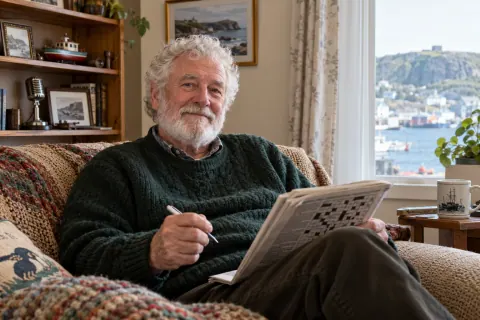
Patrick Sullivan grew up in St.
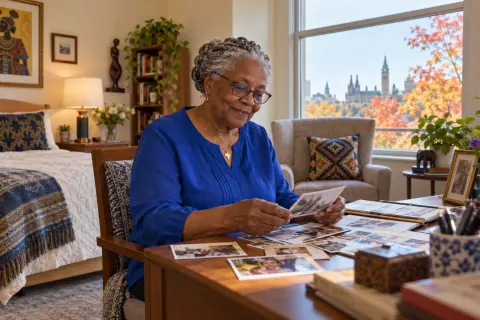
Grace Adebayo moved from Ibadan to Canada as a young adult, studied in Ottawa and became an archivist.
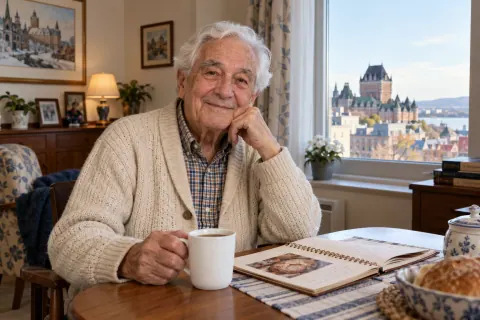
Arthur Bouchard grew up in Québec City and became a baker, working early mornings for much of his adult life.
Susan Patel grew up in Saskatoon in a family of Indian heritage and became a laboratory technician.
Edward Wilson grew up in Victoria, British Columbia, and spent most of his working life as a municipal gardener.