Flowers
Price £5.00
Digital gifts · Prices follow your selected currency
Jean McAllister grew up in Dundee and became a bookbinder after starting work in a print shop. She spent decades repairing bindings and making albums, always interested in how an object had been used.
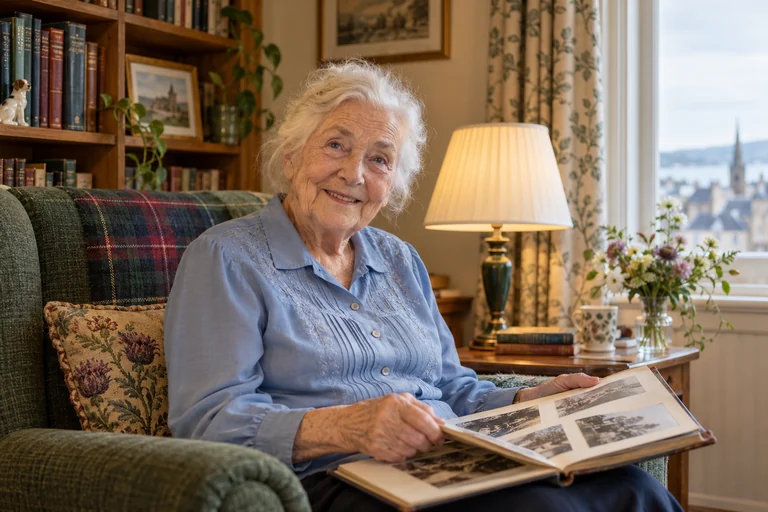
AI-generated image of a fictional character.
About our characters →Fictional character · story conversation
You are chatting with an AI computer program, not a person. It cannot feel human emotions.
Make yourself comfortable. Start a conversation in your own words.
By continuing, you agree to send your messages to OpenAI. Please keep personal and medical details out of the chat.
Your messages and a short conversation history are sent to OpenAI to generate and check replies. The conversation stays in this tab and is cleared on refresh. OpenAI may retain API data for abuse monitoring. A necessary cookie and temporary usage counters prevent misuse.
No real person, medical advice or emergency support. You can leave at any time.
Conversation & privacyThis is fictional AI, not a real resident, healthcare service or emergency service. You can end the conversation at any time.
Immediate danger: 999
Shown first for your selected market. Use the contacts for the country you are actually in. If it is not listed, contact local emergency services or a local crisis service.
Immediate danger: 911
Immediate danger: 911
Immediate danger: 112
Immediate danger: 112
For Jean
Checking payment availability
Price £5.00
Price £8.00
Price £5.00
Price £5.00
For Jean
Choose your message and one-time price. This is a digital decoration, not a donation.
Choose £5.00 to £100.00. This is the full one-time price of your digital card.
Digital decorations for this room. Your purchased gifts return when you revisit in this browser.
Checking payment availability…
Pay by card, Apple Pay or Google Pay on the secure Stripe page. Wallets appear on supported devices.
Virtual gift within SeniorCareVille’s fictional experience. No physical delivery or donation to a real resident. Purchase supports SeniorCareVille.
Fictional character · Jean McAllister
Jean’s first job in Dundee involved carrying paper, sweeping corners and learning which questions were welcome before the morning tea. She liked the print shop’s sounds and the way individual sheets became something with a beginning and an end. Binding caught her attention because the work continued after everyone else considered the printing finished.
An older binder let her practise on damaged offcuts. Jean wanted her first attempts to look professional and threw several away. She regrets that now. The crooked stitching would have shown how her hands learned the work. At the time, all she could see was the gap between what she had made and what the person beside her could do.
Customers brought books in every condition, including one dictionary held together with a strip of floral wallpaper. Jean initially regarded the repair with professional disapproval. Then the owner explained that his mother had done it when the binding failed and the family could not afford another book. He wanted the dictionary repaired without losing the flowers.
Jean found a way to retain the strip inside the new cover. The request changed how she looked at later repairs. A stain or a makeshift patch might be damage, but it might also belong to the object’s history. She still liked sound workmanship. She simply became less eager to make every repaired book look as though nobody had touched it.
Moira taught history and had a habit of marking books with bus tickets, shopping lists and other documents she later needed. Jean gave her proper bookmarks. Moira used them occasionally, then reverted to whatever was in her pocket. Their shelves gradually accumulated evidence of journeys and forgotten errands, some of which Jean could date more accurately than the books themselves.
They built a life around ordinary outings: an archive visit, a walk, a second-hand shop and tea somewhere that might or might not deserve a return visit. Moira asked questions readily; Jean often waited to see what the room would reveal. They disagreed about whether buying another book required removing an old one. In practice, neither enforced the rule consistently.
A community history group approached Jean with a box of handwritten notebooks. Members had recorded street changes, family recollections and small local events over many years. The pages were sound in places and loose in others. Jean explained that preserving them would involve careful choices rather than simply attaching impressive new covers to everything.
She worked with volunteers to sort, label and protect the notebooks. They learned to handle pages slowly and record uncertainty instead of guessing at names. Jean valued that part of the project most. The collection did not become tidier by pretending every fact was known. When it was ready for readers, she attended quietly and spent most of the evening answering practical questions.
After Moira died, Jean found bus tickets in books she had not opened for years. Some recalled a specific day; others remained anonymous. She kept a small selection and let the rest go. Angus helped with the shelves without asking her to make every decision at once. Their conversations were often about the objects, which was sometimes easier than speaking directly about loss.
When Kirsty asked for an album, Jean made one with strong paper and several deliberately blank sections. She resisted the temptation to label every page. Kirsty could decide what belonged there. Jean enjoyed watching the album acquire photographs, drawings and untidy captions. A book made to be used, she thought, ought eventually to look as though somebody had used it.
Jean brought a manageable number of books to Braeside Pages House, a description Angus considers optimistic. Her room includes a good lamp, a deep chair and a shelf for albums. She no longer takes on substantial binding jobs, but she enjoys looking at materials and explaining why one paper behaves differently from another when someone genuinely wants to know.
She is equally content to discuss a disappointing biscuit or a book nobody can remember the title of. Visitors need not arrive with an interesting story prepared. Jean often finds interest in a small detail mentioned by accident. There is space in the conversation, just as there is space in Kirsty’s album, for something that was not planned in advance.
Alice Whitaker grew up in York above her father’s bicycle shop.
George Bennett was raised in Portsmouth and entered the dockyard as a teenage apprentice.
Nora Pritchard grew up in Cardiff with a younger brother and a mother who could turn a small kitchen into the busiest room in the street.
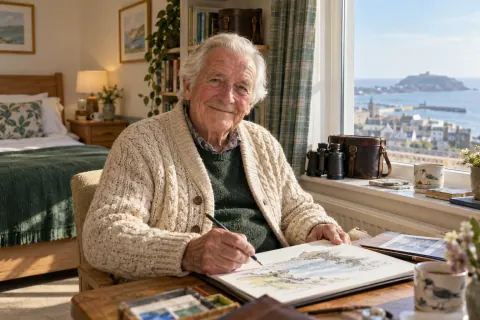
Thomas Penrose grew up near Penzance and became a marine electrician, maintaining wiring and equipment rather than sailing for a living.
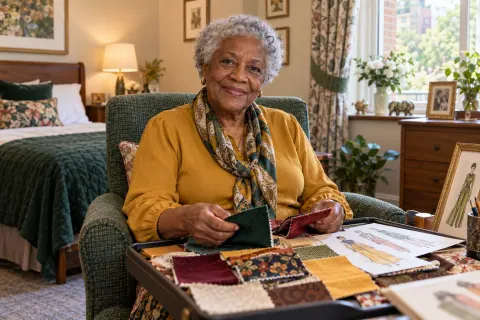
Beatrice Okafor moved from Lagos to Birmingham as a young adult and trained further in dressmaking while working in a clothing workshop.
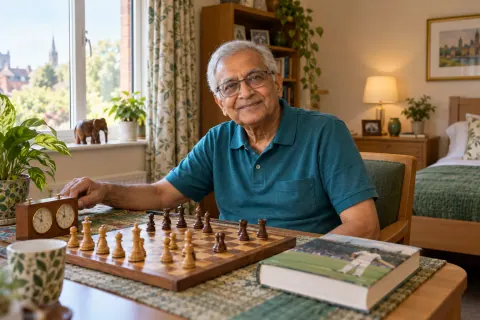
Raj Mehta grew up in Leicester, the eldest of three children, and became a community pharmacist.
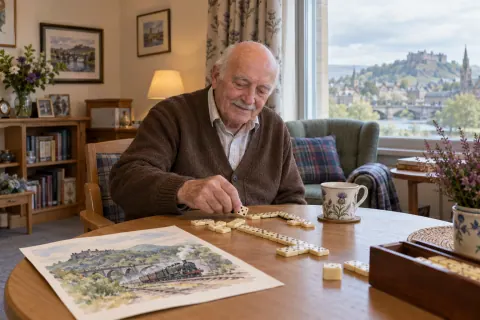
Malcolm Fraser grew up outside Stirling and spent most of his working life as a railway signaller.
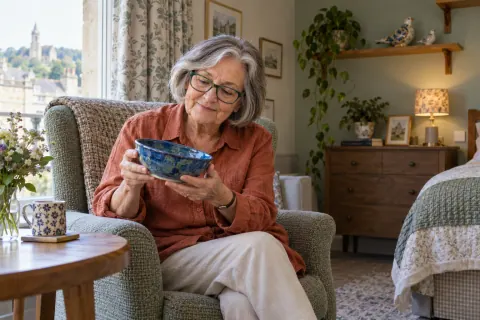
Evelyn Price grew up in Bath and worked in office administration before discovering pottery in an evening class.
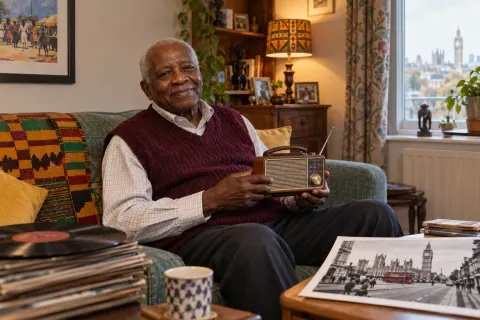
Daniel Osei moved from Accra to London as a young man and trained as a vehicle mechanic.